
Latest News
MA Glass graduate unveils ‘Naturally Focused’ glass installation in Bristol
MA Glass graduate Alison Stott has created ‘Naturally Focused’, a permanent glass and light installation for the University of Bristol’s HH Wills Physics Laboratory. Developed in collaboration with world-leading physicist Professor Sir Michael Berry, the work celebrates his 2025 Isaac Newton Medal and Lecture from the Institute of Physics.
An Arts University Plymouth MA Glass graduate will unveil a permanent glass and light installation at the University of Bristol’s HH Wills Physics Laboratory as part of a dual celebration on Thursday 27 November. The event honours Professor Sir Michael Berry’s 2025 Isaac Newton Medal and Lecture from the Institute of Physics, the organisation’s most prestigious award for world-leading contributions to physics.
Artist Alison Stott, who completed an MA Glass at Arts University Plymouth in 2025, developed the wall-based interactive work ‘Naturally Focused’ in close dialogue with Professor Sir Michael Berry, Emeritus Melville Wills Professor of Physics at the University of Bristol. Berry is a world-renowned theoretical physicist known for discovering the geometric “Berry phase” and for pioneering research in quantum chaos, catastrophe theory and singular optics, with a particular focus on the singularities and caustics of light.
The unveiling event on 27 November will bring together invited senior leaders from the University of Bristol and Arts University Plymouth, highlighting the significance of Alison’s art–science collaboration.
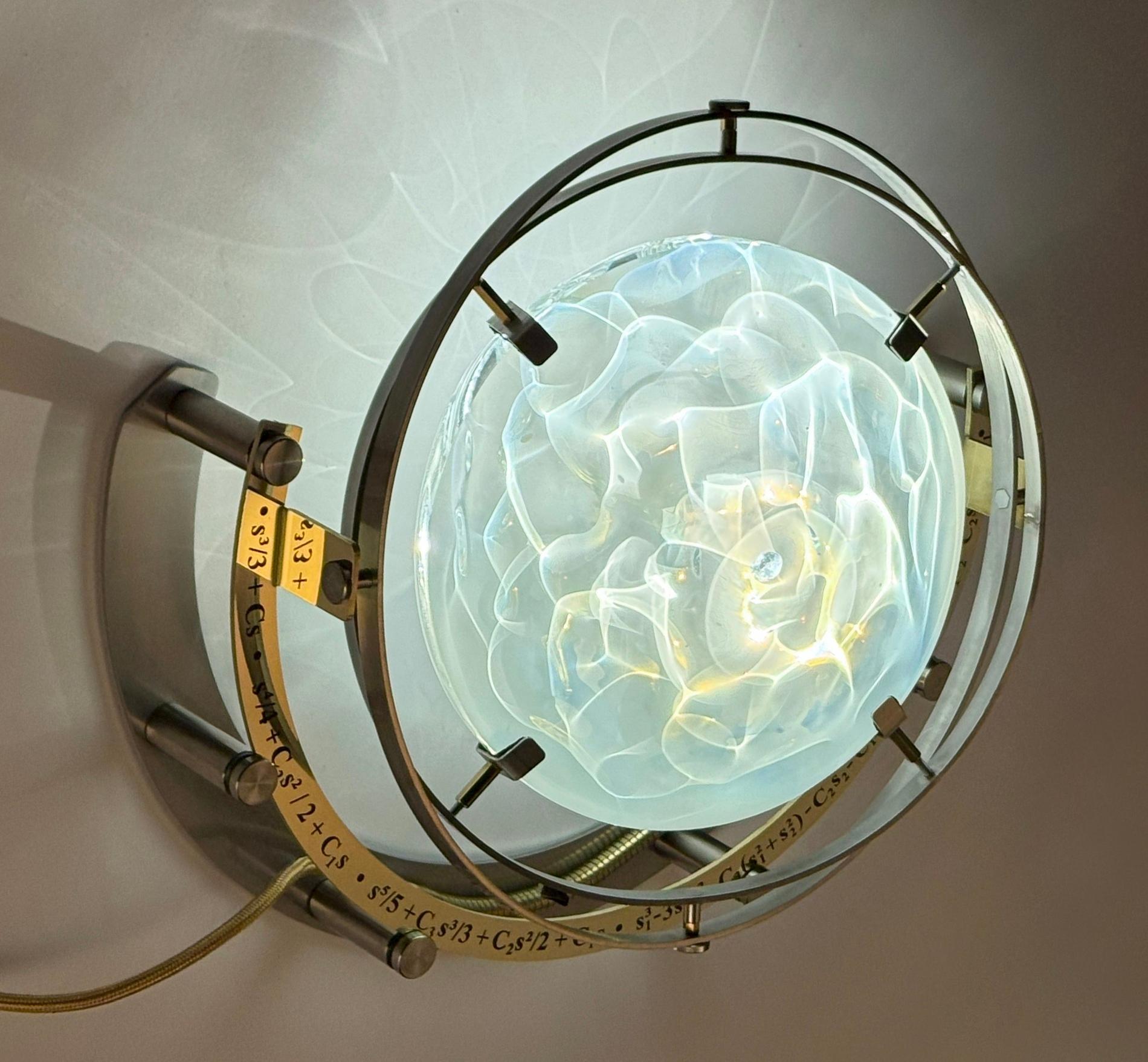
'Naturally Focused' - Alison Stott
‘Naturally Focused’ is the outcome of Alison’s sustained exploration of caustics, the bright, curved patterns that form where light rays reflected or refracted by curved surfaces concentrate, like the shimmering networks of light on the bottom of a swimming pool or the arcs of brightness cast by a glass of water.
At the heart of the work is a hand-blown glass lens created through an intuitive, responsive glassblowing process. The molten glass was shaped in dialogue with gravity, heat and breath. The cold glass was then waterjet-cut into a precise circle and highly polished so that its internal structure and optical behaviour are clearly visible. Suspended within stainless steel gyroscopic rings and held away from the wall by a polished brass support and stainless steel backplate, the entire apparatus operates simultaneously as a sculptural object and as a device which makes visible the evolving interaction between glass, light, space and viewer.
Viewers are invited to gently tilt and rotate the rings, using either sunlight or a controllable LED to activate a shifting field of caustic projections that ripple across the surrounding architecture. Mathematical equations describing the singularities of light visible on the glass surface, are engraved onto the brass. The electrical cable traces the curve of an Airy function, connecting the sculpture to diffraction patterns found at the edge of fold caustics in optics and wave physics.

Designed in CAD and fabricated using precision engineering techniques, the apparatus juxtaposes the unpredictability of hand-blown glass with the exactness of machined metal. This tension between intuition and calculation mirrors Berry’s own research in the “borderlands” between classical and quantum theories and between ray and wave optics, where subtle geometric structures govern how waves and particles behave.
Alison’s approach is grounded in an interest in “thinking not of things, but of the relations between them”, paraphrasing a quote attributed to painter Georges Braque. In ‘Naturally Focused’, meaning is not fixed in the object itself but emerges through the dynamic relations between glass, light, mathematical notation, architectural space and the bodies of those who encounter and activate the work.
Artist Alison Stott said: “Working with Michael has pushed my understanding of caustic singularities beyond their initial aesthetic appeal. The more I learn about how these structures emerge and why they matter across physics, the more compelling they become. My aim is to let the phenomena speak for themselves, creating conditions where people can directly encounter physical behaviour and perhaps feel the same awe and wonder I do.
“I hope it highlights the integrity of research, shows that both scientific and artistic inquiry begin with wonder that develops into curiosity, and demonstrates the value of collaboration across disciplines.
“I’m grateful to Michael for his generosity and clarity.”

Before starting postgraduate study, Alison spent over two decades working in visual effects (VFX) for film, television and advertising, contributing to high-profile projects including Ridley Scott’s Exodus: Gods and Kings, John Lewis Christmas adverts and Netflix’s The Crown. Her VFX career focused on creating photorealistic imagery using advanced simulation and rendering tools, frequently grappling with how to reproduce believable lighting through glass, water and atmospheric effects.
In computer graphics, physically accurate caustics are in theory achievable using sophisticated ray-tracing algorithms that calculate vast numbers of light paths through complex geometries. In a real production environment, however, tight schedules and budgets mean there is very limited time or money to devote to this level of simulation. What matters is not whether the light behaves exactly as it would in the physical world, but whether it looks convincing on screen. As a result, caustic effects in VFX are almost always approximated or “faked” rather than calculated from first principles.

After years of working within these constraints, Alison became increasingly interested in returning to physical phenomena that could not be cheated or shortcut in the same way. Glass and light offered a way to work with caustics as real, emergent events rather than digital illusions, allowing complex patterns to arise directly from the relational interaction between material, light, space and viewer. That impulse, to move from simulated effects towards lived, embodied encounters, sits at the heart of her decision to deepen this work through MA study.
Her MA research at Arts University Plymouth focused on how complex, emergent phenomena arise from simple setups, for example, a single rotating glass sculpture lit by LED in her installation ‘Entangling With Light’, creating caustic patterns that spilled into the gallery and across the bodies of visitors. Similar concerns run through public works such as ‘Waves of Radiance’ at Royal William Yard in Plymouth and ‘Lucent: A Bit of Light Relief’ at Arts University Plymouth, where suspended glass spheres, shifting LEDs and a glass-generated soundscape transform a university corridor into a meditative field of light and resonance.
Alison said: “My practice inhabits the spaces between art and science, glass and light, craft and experience. After years in digital visual effects, I came to Arts University Plymouth wanting to make “real-life” VFX that could be physically experienced. Working with molten glass lets me embrace chaos, indeterminacy, and materiality, and my work with caustics explores the co-creation of light, matter, and perception.”

Alison Stott
Since beginning the MA, Alison has rapidly established herself within contemporary glass and art–science communities. In 2025 she was highly commended for the Glass Sellers & Contemporary Glass Society Graduate Prize and shortlisted for ArtEvol 2025: Voices from the Undefined, with work featured in the Saatchi Gallery exhibition catalogue. Her sculptural series ‘Entangled Light I, II & III’ was exhibited in MIRAGE: Glass in the Fourth Dimension at London Glassblowing Gallery, complementing solo and group presentations at Arts University Plymouth’s MA Graduate Show, Midstream at Royal William Yard and exhibitions in Glasgow and Plymouth.
Alongside exhibitions, Alison is developing a distinctive research profile, speaking about art–science collaborations and singularities of light at events including the Space Ecologies Art and Design (SEADS) Meeting, the Contemporary Glass Society’s Glass in Wales Symposium, the National Astronomy Meeting at Durham University and the Making Futures conference at Arts University Plymouth. Her talks explore how glass, light and participation can offer accessible gateways into complex ideas in physics, cosmology and systems thinking.
Alison is a member of the Contemporary Glass Society and the Glass Art Society and continues to work as a visual effects supervisor and Houdini specialist, combining advanced digital skills with hands-on, materials-led experimentation in glass. She is currently pursuing further art–science collaborations and exploring ways to bring the digital and material strands of her practice into conversation through responsive technologies that enable audiences to co-create and influence the behaviour of light and glass in real time.

The story of ‘Natural Focusing Apparatus’ highlights the way Arts University Plymouth’s postgraduate community supports artists and designers to collaborate across disciplines and institutions. The MA Glass programme encourages students to develop distinctive personal practices while engaging with contemporary approaches to glass, placing them at the crossroads of traditional craft, digital technology and emerging material futures within a proactive, interdisciplinary community.
Students working in glass at Arts University Plymouth benefit from specialist hot glass facilities, a materials-led learning environment and access to wider resources including Fab Lab Plymouth, the university’s digital fabrication hub, and the on-campus public gallery MIRROR. Visiting artists and industry collaborations, such as workshops with renowned artist and Museum of Contemporary Art (MOCA) London Director Michael Petry, provide additional opportunities to test ideas at scale and build professional networks in the UK and internationally.
For Alison, the MA provided the framework to bring together advanced digital simulation, hand-blown glass, mathematical notation and collaborative research with a leading physicist into a single, ambitious project that now sits permanently within a major UK physics laboratory.

